Reading time: 5 min
GPX-Lab
Academic project
Role: Product Designer (Research, product strategy, UX, UI, prototype)


Reading time: 5 min
Academic project
Role: Product Designer (Research, product strategy, UX, UI, prototype)
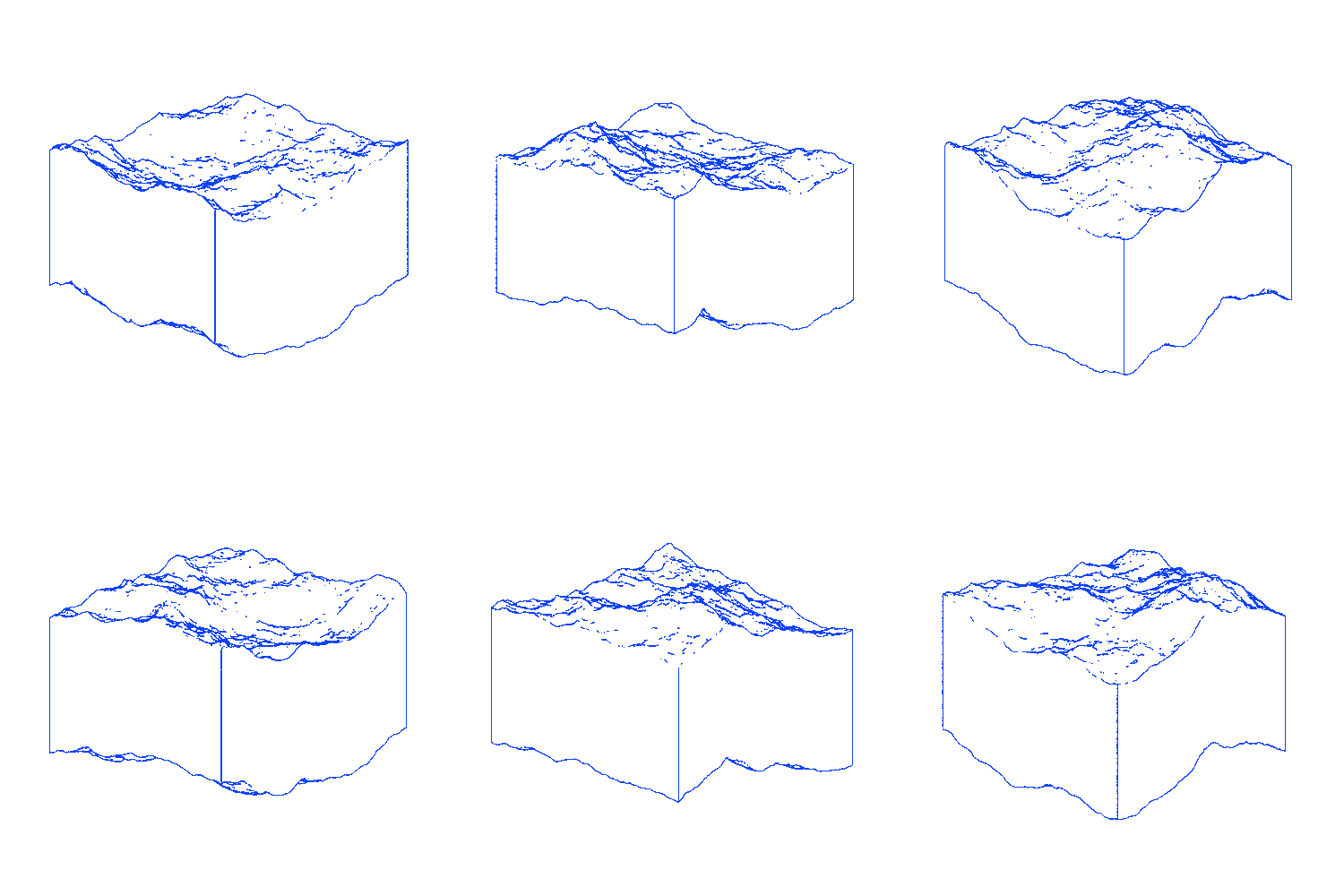
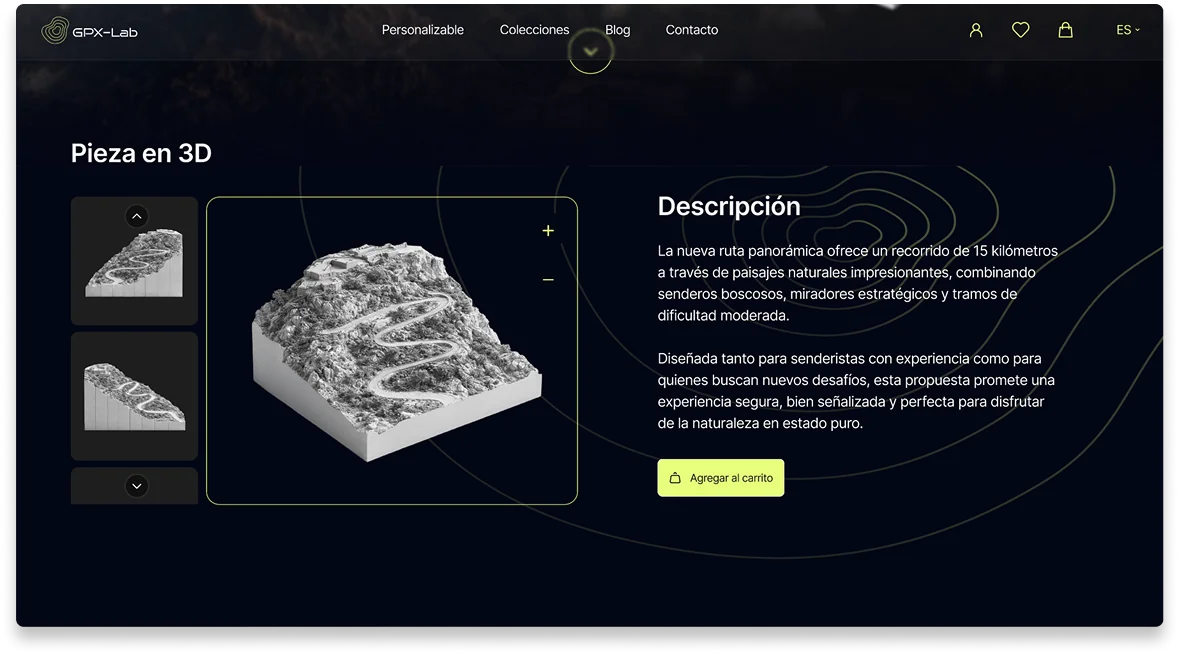
People who hike, trail run or cycle already generate a precise digital record of every experience: coordinates, elevation, distance. That data exists. The opportunity was figuring out what else could be built with it. A GPX file contains everything needed to generate an accurate 3D topography. What used to require specialist software can now be automated. That opened up a product that could turn any route into a unique physical object, at a price and with an experience that actually makes sense for the person buying it.
That summit after 1,200m of elevation. The trail they ran for the first time. The mountain that changed something. Those experiences already have a story, and the object becomes the physical version of it. A trophy of something that actually happened, that cost something, that meant something. The research backed this up. In a survey with 6 users matching the target profile, most confirmed they already keep physical memories of significant mountain experiences. The desire was there.
The research backed this up. In a survey with 6 users matching the target profile, most confirmed they already keep physical memories of significant mountain experiences. The desire was there.
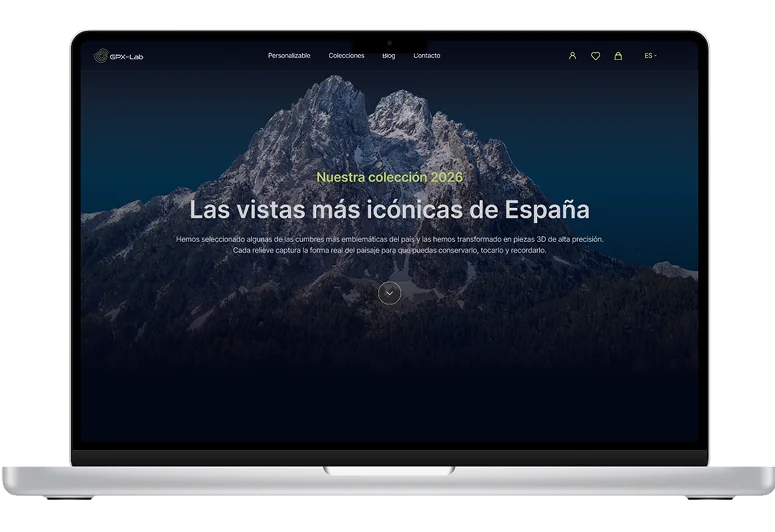
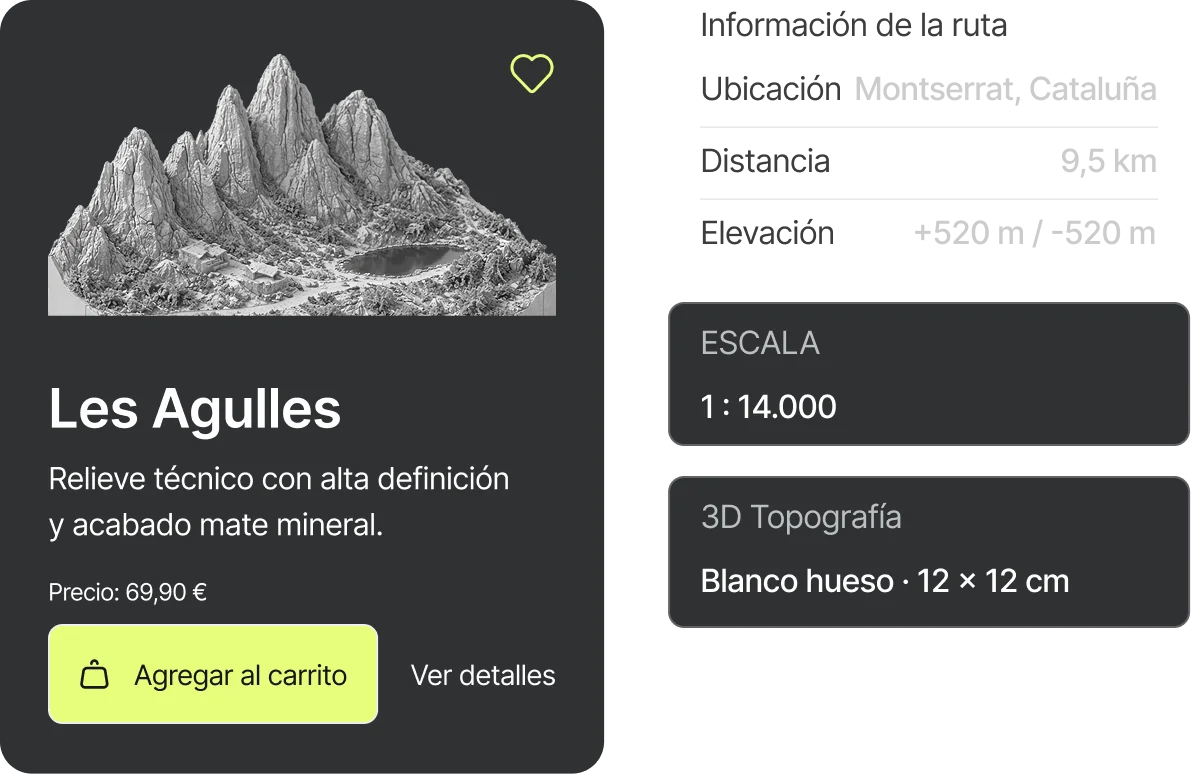
Not every user has a GPX file ready. Some know exactly which route they want. Others want something from a specific iconic mountain without having tracked it themselves. Instead of forcing everyone through the same flow, the product splits into two paths. Colecciones offers ready-made pieces from well-known routes and mountains so the user can buy with almost no friction. Personalizable gives full control to whoever has their own data and wants to use it. This also makes sense from a business angle. Colecciones covers the most famous peaks and popular trails, which drives discoverability and first purchases. Personalizable captures the user with a specific memory they want to keep.
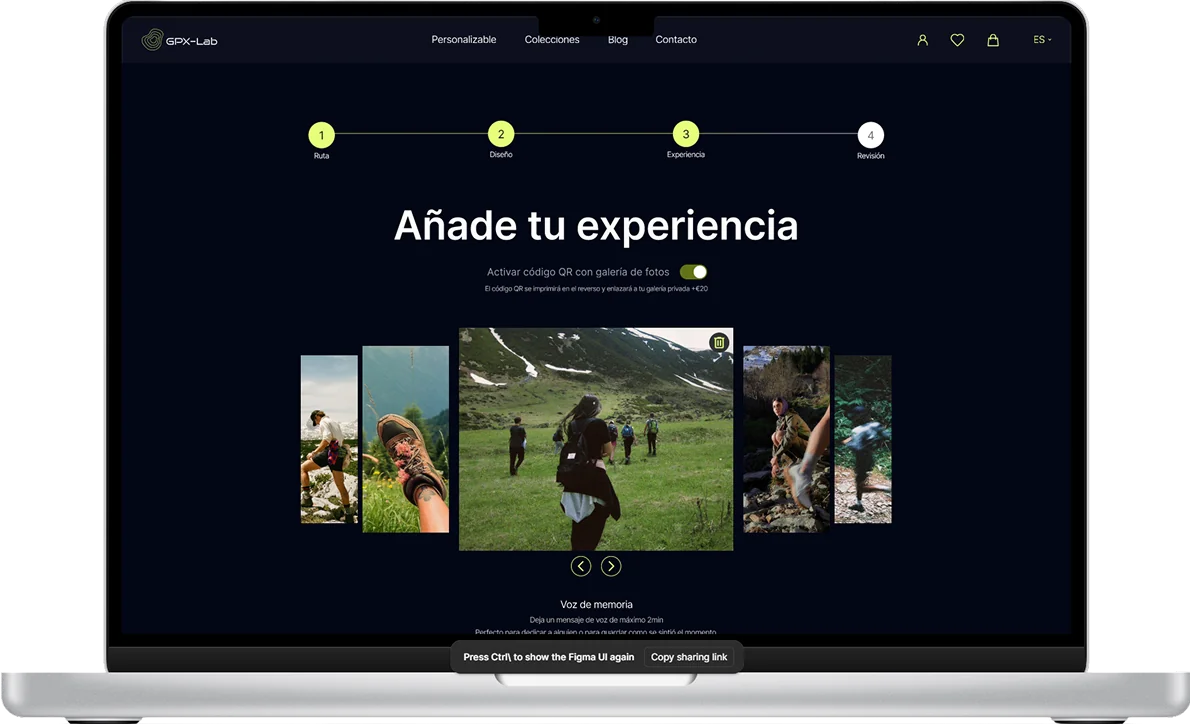
The personalization wizard is broken into four sequential steps: route, design, experience and review. This was a deliberate choice over a single page with all controls visible at once. Each step has one focus, which reduces configuration errors and keeps the user moving forward without feeling overwhelmed. By step 3, the user has already uploaded their route, seen it render in 3D and chosen materials. At that point a €20 add-on (a private photo gallery accessible via QR on the piece) doesn't compete with €20. It competes with abandoning something they've already built. That's price anchoring. That's the endowment effect. And both happen naturally when the flow is structured progressively.
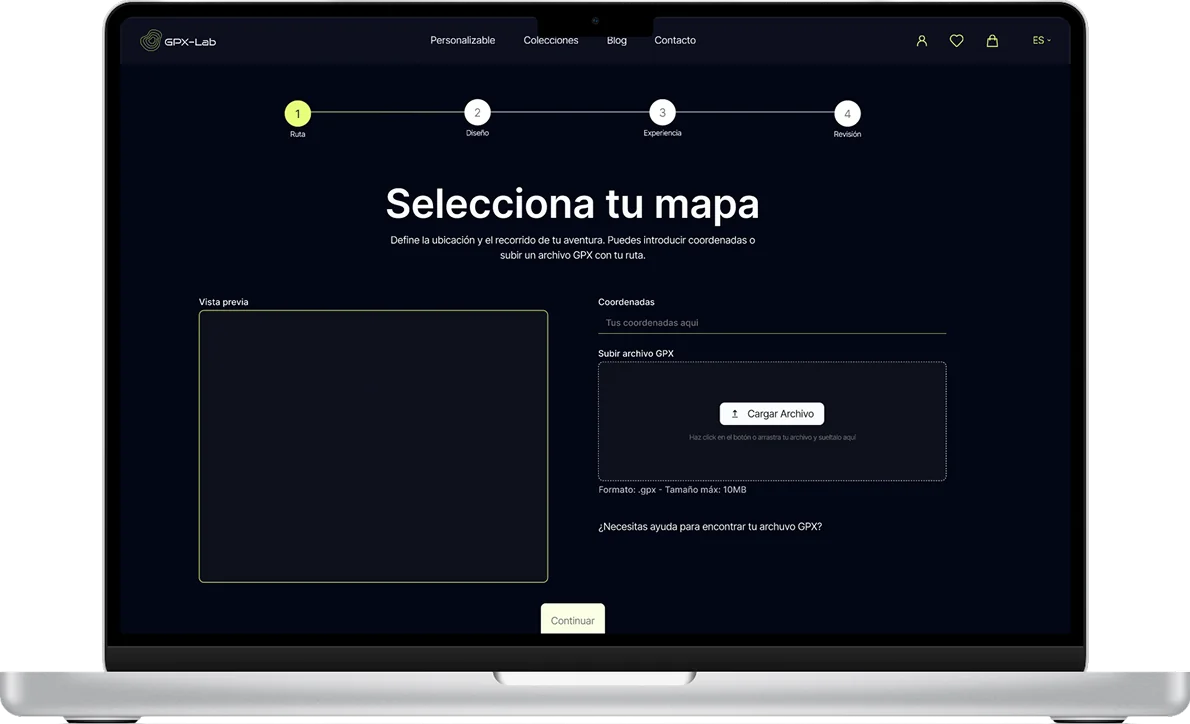
In a usability test with 6 users, several dropped off at step 1 without completing it. Not because the interface was confusing, but because they didn't know what a GPX file was or how to get one from their phone or watch. What's interesting is what they did next: most went directly to Colecciones and started looking for the mountain or route they had in mind. They didn't leave the product. They found their own workaround.
Based on industry benchmarks and simulated testing, not production data.
| Scenario | Completion rate | Projected annual revenue |
|---|---|---|
| Current design (step 1 unresolved) | ~40% | €207,360 |
| With step 1 education added | ~65% | €336,960 |
| Optimized + QR upsell at 30% | ~65% | €346,320 |
In a usability test with 6 users, several dropped off at step 1 without completing it because they didn't know what a GPX file was or how to get one from their phone or watch. What's interesting is what they did next: most went directly to Colecciones and started looking for the mountain or route they had in mind. They didn't leave the product. They found their own workaround.
The conversion mechanics behind the 4-step structure came first as an intuition while designing. Once it was completed, I implemented the idea of reinforcing what was already there with an emotional attachment. During the interviews the idea of a memory or a trophy always came up, but once the memory gallery was added it increased the rate so that even something as small as a 5% conversion adds to the revenue of the company. Next time, conversion objectives come first.
More